
You’ve tried the baking soda. You’ve gone through two bottles of enzyme spray. You’ve opened the windows, lit the candles, and done everything the internet told you to do. And the smell is still there.
If you’re a pet owner in New York City dealing with stubborn odors baked into your couch or carpet, you already know that surface-level solutions do not reach the actual problem. Pet urine, dander, and the biological compounds behind that distinct smell do not sit on top of fabric. They soak through it, seep into foam cushions, settle into carpet backing, and bind to fibers in a way that grocery store sprays simply cannot reverse.
This guide covers what is actually happening when pet smells and stains linger, which DIY approaches work and which ones waste your time, and when professional pet odor removal for a couch in NYC is the only thing that genuinely resolves it. Whether you’re dealing with a dog urine accident on a sectional in Brooklyn or a cat smell couch situation in a Manhattan apartment, the information here will give you a clear picture of your options.
Why Pet Odors Are So Difficult to Remove From Couches and Carpets
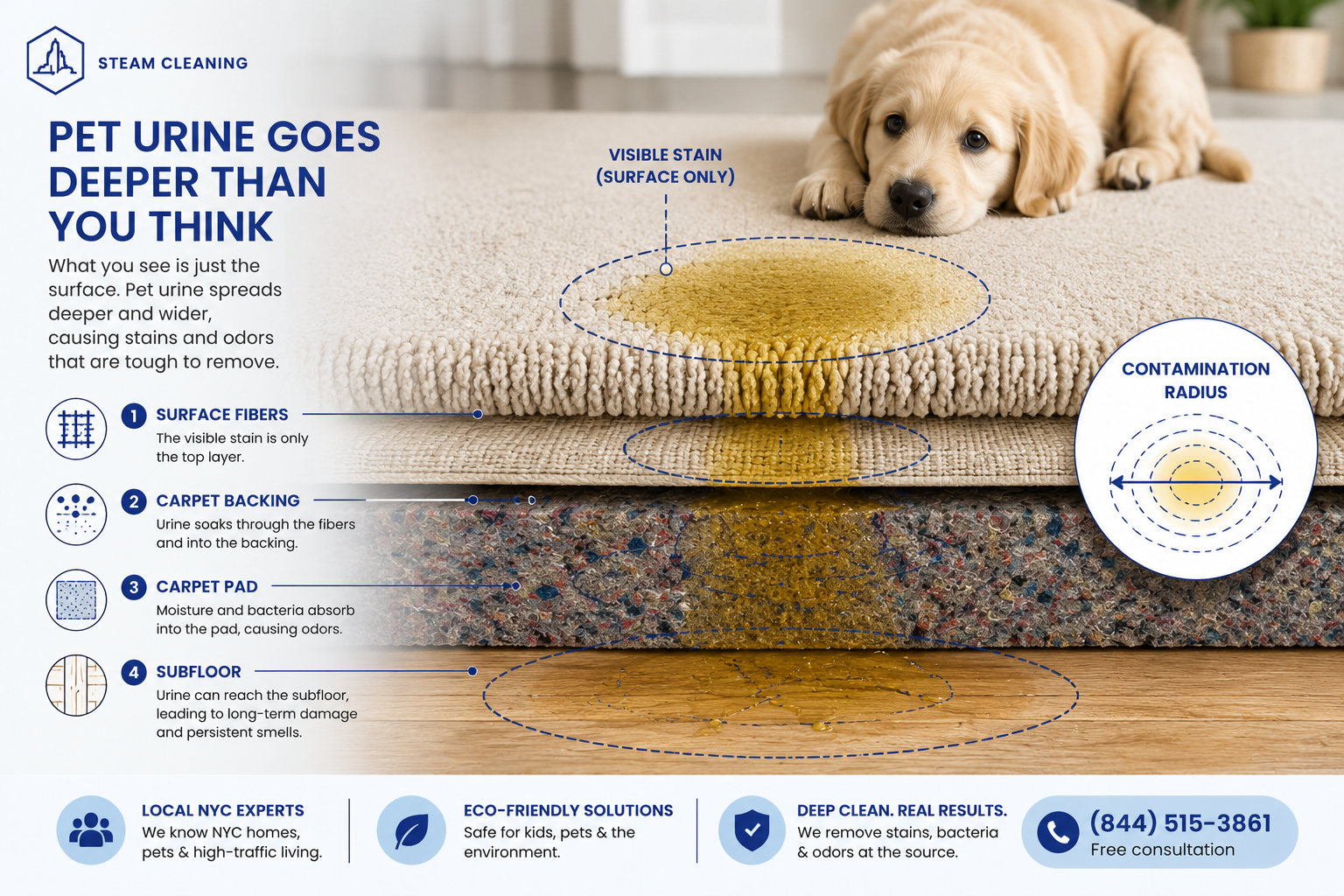
The reason pet smells persist after cleaning has everything to do with chemistry, not effort. When a pet urinates on a couch or carpet, the liquid immediately begins to move. On a cushioned sofa, urine travels through the fabric cover, into the foam core, and sometimes all the way to the wood or metal frame underneath. On carpet, it penetrates through the pile, through the backing, and into the padding and subfloor beneath.
Once the surface dries, the water evaporates but the uric acid crystals remain. Those crystals are odorless when dry, which is why a freshly dried stain sometimes seems like it has been handled. But when humidity rises, those crystals reactivate, releasing the ammonia-based smell again. This is why pet odor seems to come back after rain, after steaming a bathroom, or simply on warm days.
Dander compounds this further. Dog and cat dander, the microscopic skin particles that trigger allergies and carry the biological scent markers of the animal, accumulates in upholstery fibers over months. It is not visible. It does not wash out with standard upholstery cleaner. And in a New York City apartment where furniture and floor space are shared closely with pets year-round, the concentration builds quickly.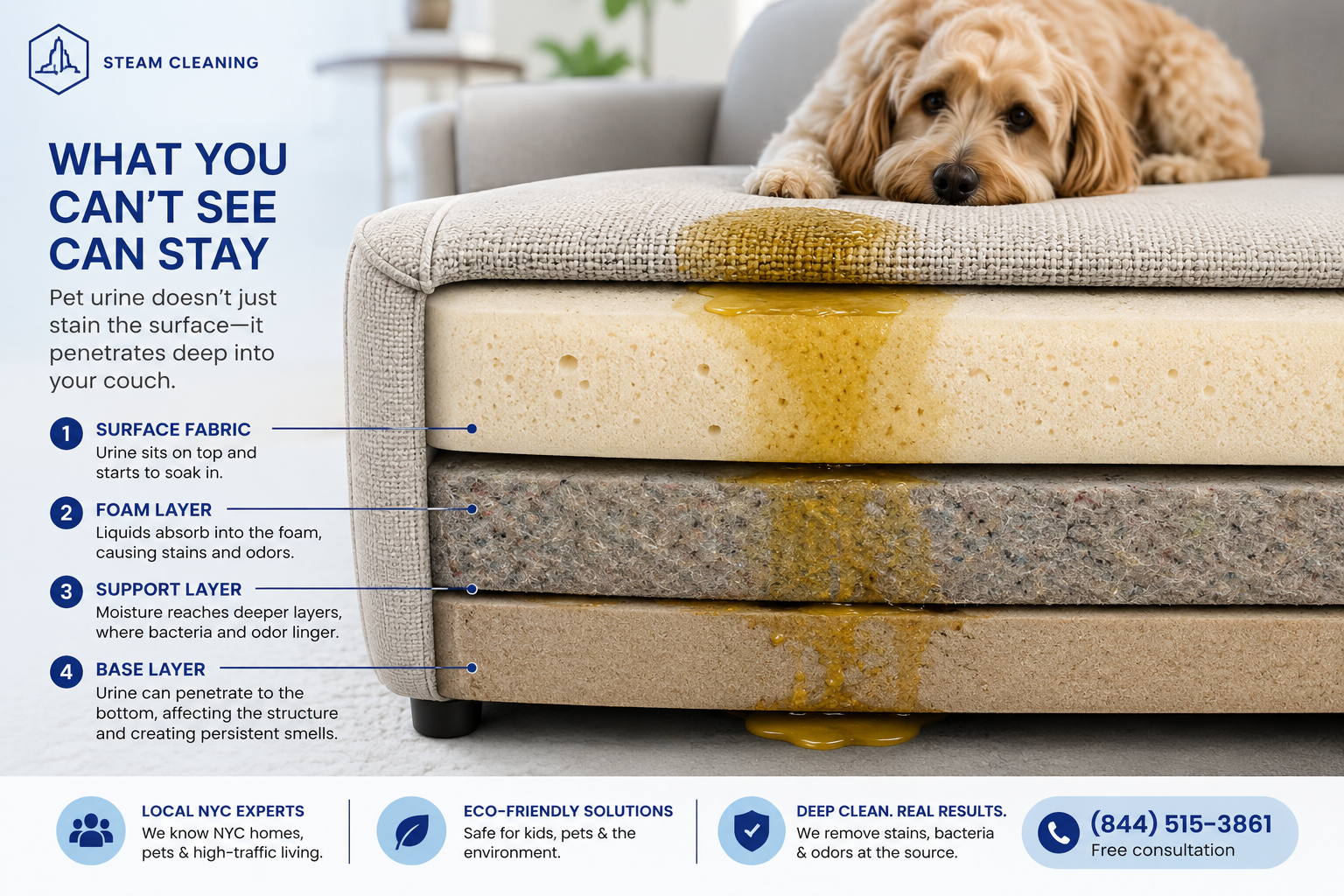
What Actually Causes That Persistent Cat or Dog Smell on Your Sofa
Why Cat Urine Is Harder to Remove Than Dog Urine
Cat urine contains higher concentrations of certain compounds, including felinine, a sulfur-containing amino acid that breaks down over time into increasingly pungent molecules. This is why cat smell on a couch or carpet tends to get worse with age rather than fading. A stain that was barely noticeable six months ago can become overwhelming by the time warmer weather arrives.
Cats also tend to return to the same spot repeatedly, which compounds the saturation over time. By the time most NYC cat owners reach out about cat smell couch cleaning, the foam inside the cushion has been saturated multiple times across multiple incidents.
Why Dog Urine Stains on Carpet Are Notoriously Stubborn
Dog urine carpet situations in New York apartments are usually the result of a single accident that was not fully extracted at the time of the incident. Standard paper towel blotting removes maybe 20 to 30 percent of the liquid. The rest migrates downward and spreads outward as it dries, meaning the stain you see on the surface is significantly smaller than the contaminated zone underneath.
Older dogs with incontinence issues or puppies in the training phase can create overlapping contamination zones across carpet that eventually merge into a broader odor source that no single-treatment approach can address.
The DIY Methods That Help and the Ones That Do Not
Not all home remedies are useless. Some approaches genuinely reduce odor and help with surface staining, and it is worth knowing which ones are worth your time before calling a professional.
What Actually Works on Fresh Stains
Speed matters more than anything else on a fresh accident. The faster you extract the liquid before it migrates, the less saturated the underlying materials become.
- Blot, do not rub. Rubbing spreads the stain and pushes it deeper into the fabric.
- Use a wet-dry vacuum or extraction machine if you have one. Hand blotting leaves the majority of liquid behind.
- Apply an enzyme-based cleaner after extraction. Enzyme cleaners break down uric acid crystals chemically and genuinely help on recent stains that have not yet fully set.
- Keep the area ventilated while it dries to reduce recrystallization.
What Does Not Work on Set Stains
Once a pet stain has dried and the uric acid has crystallized into fabric fibers or foam, the following approaches are largely ineffective:
- Baking soda and vinegar can neutralize surface odors temporarily but do not penetrate foam or carpet backing deeply enough to reach the contamination source.
- Febreze and fabric sprays mask the smell for hours or days but do nothing to the underlying compound. Once humidity reactivates the crystals, the odor returns.
- Steam mop treatments at home can actually make the situation worse by pushing heat into the area, which accelerates the chemical reaction that produces ammonia odor.
- Carpet shampooers without extraction wet the fibers without fully removing the contaminated water, sometimes spreading the affected zone wider.
The honest reality is that for stains older than 24 to 48 hours on a couch or carpet, DIY methods are unlikely to fully eliminate the problem. They reduce it. They do not resolve it.
Method | Surface Odor | Deep Odor | Stain Removal | Safe for Foam and Backing |
Baking soda and vinegar | Partial | No | Partial | Yes |
Enzyme spray (fresh stain) | Yes | Partial | Yes | Yes |
Fabric deodorizer sprays | Temporary | No | No | Yes |
Home steam mop | Partial | Can worsen | Partial | Risk of heat damage |
Professional hot water extraction | Yes | Yes | Yes | Yes, when done correctly |
Professional steam cleaning with enzyme treatment | Yes | Yes | Yes | Yes |
How Professional Pet Odor Removal Actually Works on Couches and Carpets
Professional pet odor removal for a couch in NYC is not just a more powerful version of what you do at home. The process is categorically different in terms of the equipment used, the temperature reached, and the depth of treatment applied.
The Professional Cleaning Process for Pet-Affected Upholstery
A proper professional treatment for a pet-odor couch typically involves several stages:
- Pre-inspection and UV light scanning. UV light reveals the full extent of contamination, including stains that are invisible under normal lighting. On many sofas we treat, the actual contaminated area is two to three times larger than what the client could see.
- Pre-treatment with enzyme solution. The enzyme formula is applied and allowed to dwell, beginning the process of breaking down uric acid crystals throughout the fabric and into the foam layer.
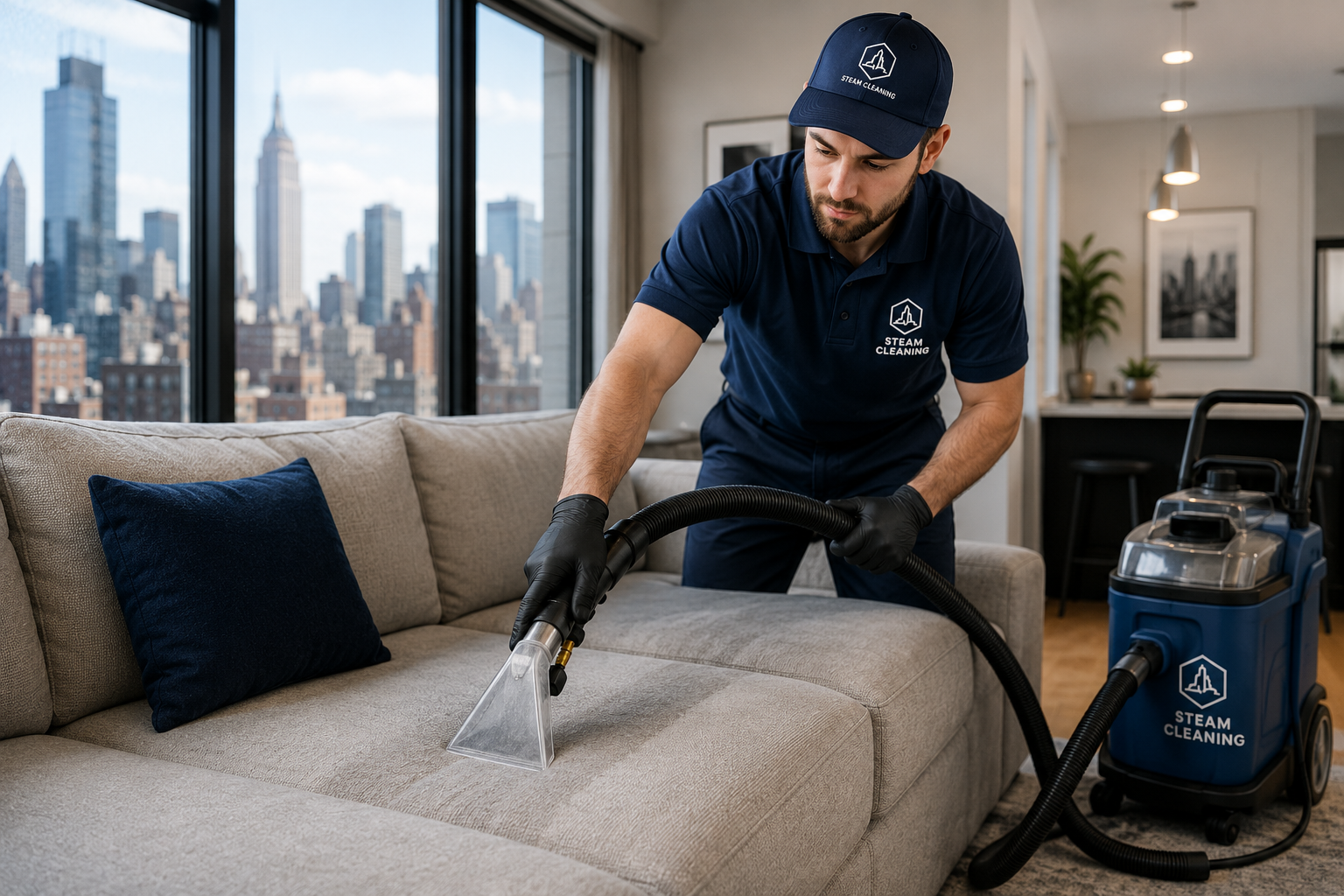
- Hot water extraction. High-temperature water is injected into the upholstery and immediately extracted along with the dissolved contamination, pulling the broken-down compounds out of the foam rather than leaving them inside the cushion.
- Deodorizing treatment. A professional-grade neutralizing solution is applied to address any residual odor compounds after extraction.
- Express drying. Professional drying equipment accelerates the drying process, which is particularly important in NYC apartments where ventilation is limited and slow drying can lead to mildew.
Why NYC Apartments Require a Different Approach
New York City apartments present specific challenges that do not apply in most other markets. Furniture is used in smaller, more densely occupied spaces. Many NYC residents share studios or one-bedroom apartments with one or more pets, meaning the couch is the primary seating surface and is in constant contact with the animal. Ventilation in older prewar buildings is limited, which allows odors to concentrate.
Neighbors in adjoining units, particularly in co-ops and condos, can be affected by odors that migrate through walls and shared ventilation systems. This is a concern we hear regularly from clients across Manhattan, Brooklyn, and Queens, and it changes the urgency calculation significantly.
Couch Fabric Type Changes Everything About Treatment
Not all couches respond to the same cleaning approach, and the fabric type on your sofa determines both the method used and the realistic outcome you should expect.
Fabric and Microfiber Sofas
Fabric and microfiber are the most commonly treated upholstery types for pet odor in NYC. They are porous and absorb urine readily, but they also respond well to hot water extraction when the treatment is done correctly. Microfiber in particular can look dramatically better after professional cleaning because the deep extraction removes embedded dander and residue that normal vacuuming never reaches.
Leather and Faux Leather Sofas
Pet odors on leather sofas are usually less severe because the surface does not absorb liquid the way fabric does. However, if urine reaches seams or the underside of cushions, the same saturation problem applies. Leather requires different cleaning agents and lower temperatures to avoid drying or cracking the material.
Velvet, Linen, and Delicate Upholstery
These materials require a gentler approach and careful moisture control. Overwetting velvet or loosely woven linen can cause watermarks and texture damage. Professional treatment on these fabrics involves lower moisture techniques and specialized products, which is one reason a professional assessment before treatment is always worth doing.
What Does Professional Couch and Carpet Pet Odor Cleaning Cost in NYC
Pricing for professional pet odor removal on a couch or carpet in New York City depends on several variables: the size of the piece, the fabric type, the severity and age of the contamination, and whether additional treatments are required for deep foam saturation.
General ranges for context:
Service | Typical NYC Range |
Standard couch cleaning (2-3 seat sofa) | Starting around $120 to $180 |
Pet odor treatment add-on | Additional cost depending on severity |
Carpet cleaning per room | Varies by room size and condition |
Rug cleaning (in-home) | Depends on size and fiber type |
At Today’s Steam Cleaning, pricing is upfront and confirmed before we begin any work. There are no hidden fees, no surprise charges added after the job, and no pressure to add services you do not need. New clients also receive 15 percent off their first service, and couch cleaning currently includes free express drying as a limited promotion.
Why Waiting Makes Pet Odor Problems Significantly Worse
You’ve probably noticed that the smell seems manageable in winter but becomes much more noticeable in summer. That pattern is not your imagination. Warmer temperatures and higher humidity directly activate the odor compounds in uric acid crystals, which is why pet odors that seemed tolerable in March can feel overwhelming by July.
Waiting also allows the contamination to spread further. Uric acid crystals continue to react with the organic material in foam and carpet fibers over time, deepening the chemical bond that makes professional extraction necessary in the first place. A stain treated within a few days is significantly easier and less expensive to resolve than the same stain treated six months later.
For NYC renters specifically, this has real financial consequences. Security deposits, lease renewals, and neighbor relations are all affected by persistent pet odors in a way that does not apply in the same way to detached homes with more space and ventilation.
How Today’s Steam Cleaning Handles Pet Odor Jobs Across NYC
At Today’s Steam Cleaning, we have been handling pet odor removal on couches and carpets across New York City since 2015. Our team of over 120 professional cleaners is trained specifically on the challenges that NYC apartments present, from navigating elevator buildings in Manhattan to handling the older carpet installations common in prewar Brooklyn co-ops.
We use eco-friendly, non-toxic cleaning products on every job. That is not a marketing claim. It is a standard we hold because our clients have children and pets in the same spaces we treat, and introducing harsh chemical residues into a fabric sofa or carpet that a child or dog will be lying on defeats the purpose of the cleaning entirely.
Our process for pet odor jobs includes UV scanning before we start, enzyme pre-treatment, professional hot water extraction, and express drying before we leave. We do not consider the job complete until the odor source has been addressed, not just the surface.
We serve all NYC boroughs, including Manhattan, Brooklyn, Queens, and The Bronx, with appointments available seven days a week from 8 AM to 8 PM.
Should You Clean or Replace a Pet-Damaged Couch or Carpet
This is a question we get asked regularly, and the honest answer depends on the degree of saturation and the age and condition of the piece.
For most couches, professional cleaning is absolutely worth attempting before replacement. A quality sofa in NYC can cost anywhere from $800 to several thousand dollars to replace, and in many cases the foam and fabric respond well enough to professional extraction that replacement becomes unnecessary. Many clients come to us expecting to have already decided to replace the couch, and leave with a restored piece that no longer has an odor issue.
The situations where replacement makes more sense include very old foam that has been saturated repeatedly over many years, structural damage to the frame or base, or pieces where the fabric is already deteriorating from wear.
For carpet, the calculation is different. If pet urine has reached the subfloor beneath the carpet padding, professional cleaning can address the carpet and padding but cannot reach the subfloor without more intensive remediation work. In those cases, we will tell you directly what we can achieve and what the realistic outcome is before we start.
Ready to Actually Solve the Pet Odor Problem in Your NYC Home?
You should not have to live with a smell that no amount of spraying and scrubbing has fixed. If you’ve been dealing with dog urine on carpet, a cat smell couch situation, or persistent pet odor on any upholstered surface in your New York City apartment, our team can assess the situation and give you a clear answer about what professional treatment can achieve.
Fill out the quick booking form on our contact page or call us directly at (518) 348-8887 to schedule your appointment. New clients receive 15 percent off their first service, and couch cleaning currently includes free express drying.
You can also learn more about our full upholstery cleaning services, couch cleaning, and carpet cleaning to understand what the process looks like for your specific situation.
Frequently Asked Questions About Pet Odor Removal on Couches and Carpets in NYC
Does professional steam cleaning actually remove pet odor or just cover it up?
Professional steam cleaning using hot water extraction physically removes the uric acid crystals and biological compounds responsible for the odor. When done correctly with enzyme pre-treatment and professional extraction equipment, it eliminates the odor source rather than masking it. This is fundamentally different from sprays and deodorizers, which only affect the surface.
How long does pet odor removal on a couch take in NYC?
Most couch cleaning appointments for pet odor treatment take between one and two hours depending on the size of the sofa, the fabric type, and the severity of the contamination. Express drying is included in our couch cleaning service, which significantly reduces the time the furniture is out of use.
Can old pet stains be removed from carpet professionally?
Yes, in most cases. Older stains require a longer enzyme dwell time and more intensive extraction, but professional cleaning can address set stains that DIY products have had no effect on. The exception is when saturation has reached the subfloor beneath the carpet pad, which may require additional remediation beyond standard carpet cleaning.
Is professional pet odor cleaning safe for cats and dogs?
At Today’s Steam Cleaning, we use eco-friendly and non-toxic cleaning products on every job. Your pets can be in the treated area once the surface is fully dry, which our express drying process accelerates. You do not need to keep animals out of the home for extended periods after treatment.
Why does the pet smell come back after I clean it myself?
The smell returns because DIY methods address the surface but not the uric acid crystals that have set into the foam, carpet padding, or fiber structure. When humidity rises, those crystals reactivate and release the odor again. Professional hot water extraction removes the crystals rather than temporarily neutralizing them.
How much does pet odor couch cleaning cost in NYC?
Pricing depends on the size of the sofa, the fabric type, and the severity of the contamination. At Today’s Steam Cleaning, we provide upfront pricing with no hidden fees before any work begins. New clients receive 15 percent off their first service.
Can you clean cat urine out of a microfiber couch?
Yes. Microfiber responds well to professional hot water extraction and enzyme treatment. Cat urine is more concentrated than dog urine and typically requires a longer pre-treatment dwell time, but microfiber sofas are among the most successfully treated fabric types for pet odor removal.
Do you serve all NYC boroughs for pet odor cleaning?
Yes. Today’s Steam Cleaning serves Manhattan, Brooklyn, Queens, and The Bronx. Appointments are available seven days a week from 8 AM to 8 PM.
What is the best way to prevent pet odors from building up on furniture?
Regular professional cleaning every six to twelve months significantly reduces the accumulation of dander and residual urine compounds in upholstery and carpet fibers. Between professional cleanings, prompt extraction of fresh accidents with enzyme-based cleaners and a wet-dry vacuum prevents stains from setting. Using furniture covers that can be washed regularly also reduces direct fiber contamination.
Should I replace my couch or have it professionally cleaned first?
In most cases, professional cleaning should be attempted before replacing a pet-affected couch. A quality sofa in NYC is a significant investment, and professional extraction resolves the odor problem in the majority of cases. We will always give you an honest assessment of what is achievable before starting work, so you can make an informed decision rather than guessing.